

Both Small-Angle X-ray Scattering (SAXS) and traditional X-ray diffraction (XRD) use X-rays to probe the structure of materials. What’s the key difference?
Answer: SAXS probes larger-scale nanoscale structures, while standard XRD probes atomic-scale crystal structure.
Traditional powder XRD (or wide-angle X-ray scattering, WAXS) examines scattering at wider angles, revealing atomic-scale structure, crystal phases, and lattice spacings. SAXS looks much closer to the direct X-ray beam, allowing us to investigate larger nanoscale features such as particle size, pores, aggregates, and other structural organization. While standard wide-angle XRD requires crystalline materials, SAXS does not depend on crystallinity.
What kinds of samples are studied by SAXS?
Applications span many fields and include polymers and soft materials, proteins and other biomolecules, nanoparticles and colloids, porous materials, and pharmaceutical formulations. SAXS is particularly useful when the structure of interest falls between the atomic scale and what can readily be observed by microscopy. SAXS is compatible with crystalline, semi-crystalline and amorphous materials.
Did you know ARC can do SAXS?
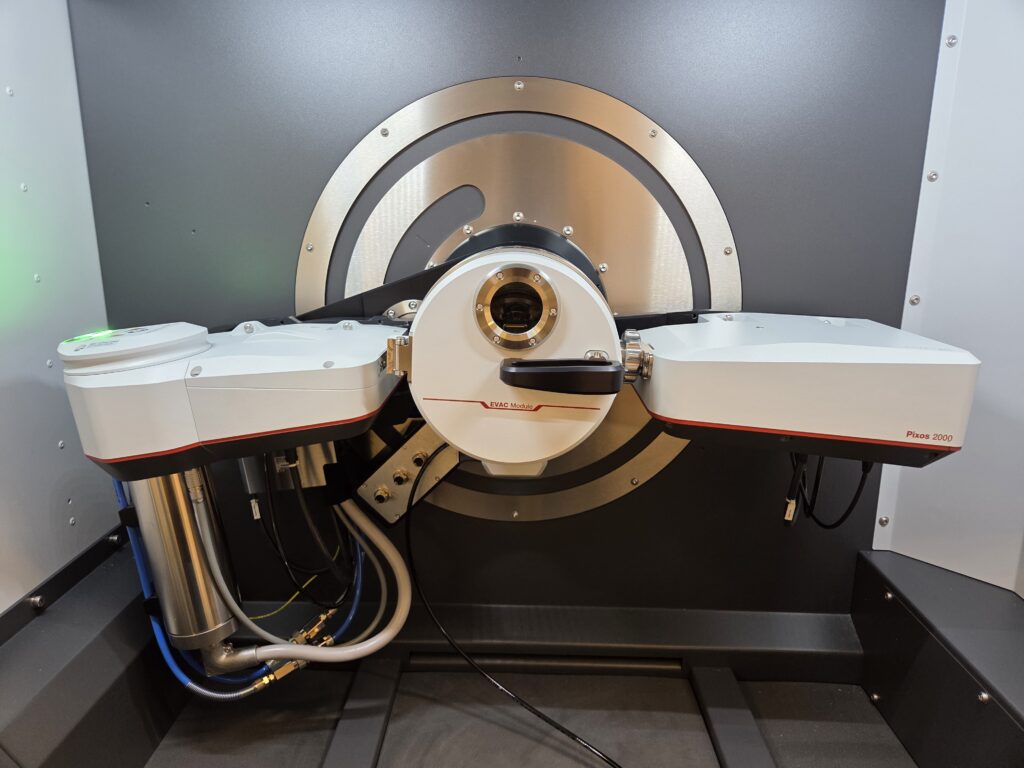
Our Anton Paar XRDynamic 500 can collect SAXS data down to approximately q = 0.05 nm⁻¹, corresponding to structural spacings up to ~125 nm and particle sizes up to roughly ~60 nm. This makes it useful for studying smaller nanoscale structures, although it does not have the extended low-q range of a dedicated SAXS instrument.
Our unique advantage?
The XRDynamic 500 can collect SAXS and WAXS data simultaneously, letting researchers examine nanoscale organization and crystalline structure in the same experiment. Experiments are performed under vacuum, and SAXS measurements can accommodate both solid and solution-based samples.
Curious whether SAXS could work for your samples? Contact Dr. Ethan Crace to discuss your application!