
Proposal Writing
Proposal Development: Strategy & Administration
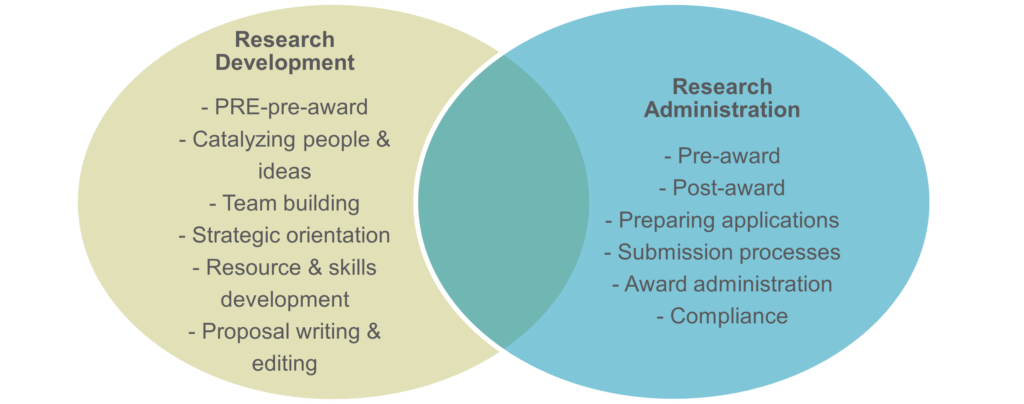
Proposal Development encompasses the Research Development and Research Administration elements necessary to the preparation and submission of funding proposals. While the Research Acceleration Office (Research Development) focuses on the strategic aspects of this process and the Office of Sponsored Programs (Research Administration) focuses on the administrative components, strategy and administration share an area of overlap. Strategy informs what is included in administrative documents, and strategic processes often involve administrative requirements. Thus, the two offices work closely together to support proposal development at CSU.
Common Proposal Elements
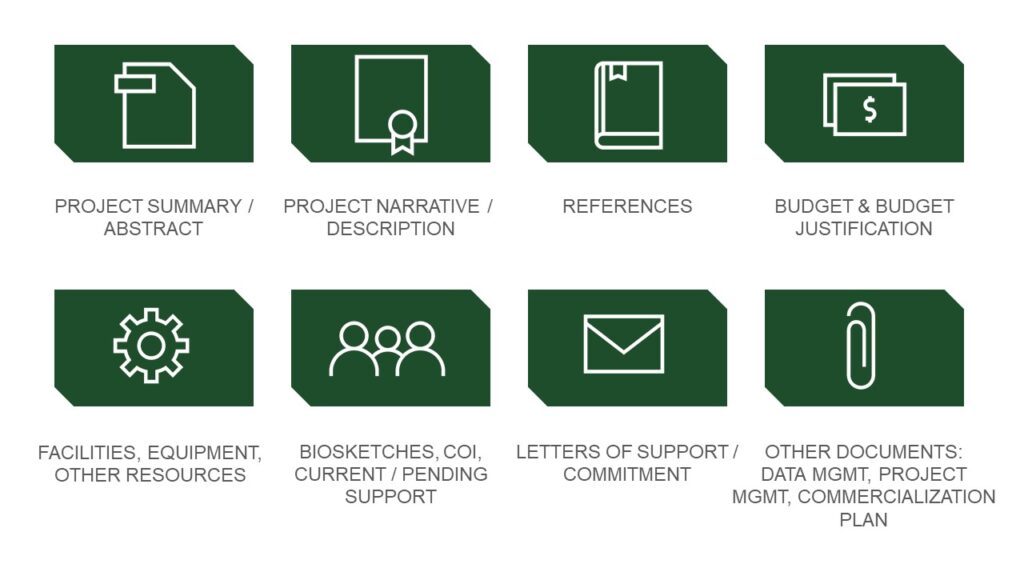
In addition to proposal writing, proposal development involves the preparation of multiple elements that convey the proposed work within its larger strategic context of infrastructure, institutional support, partnerships, previous work, future plans–and more. Common proposal components are depicted below.
Proposal Development Timeline
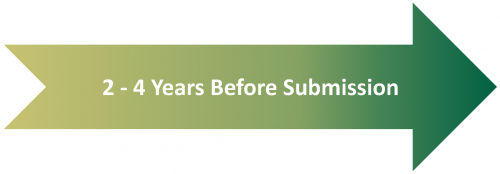
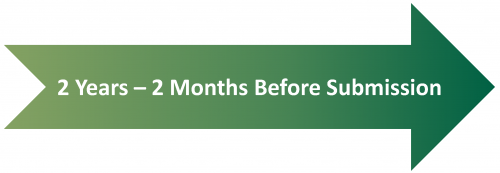
The Proposal Development Timeline Hanover Research webinar
Administrative
• Successful Close to Previous Projects
• Annual Reports Completed
• COI Current
• Compliant Financial Management of Current and Prior Awards
Strategic
• Alignment of Internal Seed Investments
• Research Development Roadmap
• Government Affairs
• Advocacy with Funding Agencies/Legislative Affairs to Create Aligned Opportunities
• Cultivation of Internal Team & Resources
• Faculty Training, Curricular Engagement, IRISS
• $, Collaborative Publications, Track Record of Success
• Small “Feeder” Proposals
• Cultivation of External & Internal Partnerships
• Industry Research Contracting, Corporate Relations, STRATA
Administrative
• Partnership MOUs, NDAs, etc.
• Required Documentation
• Sponsor Portal Registrations
• Familiarity with Funding Announcement
Strategic
• Find Funding Opportunities
• Proposal Development of Big Bet (1-2 years)
• Early Concept Development
• Blue (outline/early alignment) Pink (50-75% complete) Iterative Drafts & Review Cycles
• Partnership Engaging
• Senior Personnel Documents
• Selection for Limited Opportunities
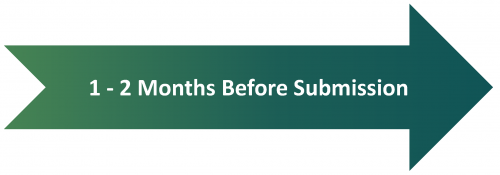
Administrative
• Complete Necessary Registrations in Sponsor Portals
• KRPD Record
• Finalize Proposal Narrative & Required Attachments
• Finalize Key Personnel Documents
• College/Departmental Review
Strategic
• Develop Proposal Narrative & Required Attachments
• Elevate Key Personnel Documents
• Selection for Limited Opportunities
• Writing & Review Cycles
Pink (50-75% complete) & Red (75-95% complete) Proposal Content Review
Color Team Reviews
Stages of proposal development are color-coded from conception to completion. Each color “team” symbolizes a level of review expected at a given draft stage as the proposal is refined prior to submission.

Blue Team Reviews are conducted at the earliest stage of proposal development and usually involve big-picture strategizing, personnel selection, and project outlining.
Pink Team Reviews are administered when the proposal draft is more than halfway complete; ideas are expressed in detail, but major points may still be added or removed from the text.
Red Team Reviews take place when the proposal is close to final and includes graphics, data, and personnel documents that are nearly complete; the review team focuses on accuracy, compliance, and cohesion.
Green Team Reviews involve close inspection of budgetary requirements and all financial details of the proposal.
Gold Team Reviews occur when the proposal has been readied for submission; reviewers at this stage focus on high-level elements that are key to the proposal’s overall success.
White Team Reviews are best remembered as “white glove” reviews in which reviewers check the proposal for formatting, typographical, and compliance issues that may have previously eluded scrutiny.
Proposal Writing
Proposals require a special sort of writing. While great attention must be paid to the laying out of goals, the research process, and other components, proposal writers must also remember to craft a narrative–they are telling the story of their projects and describing why others should care about them, too.
Grant writing is persuasive writing. You are selling your idea, your project, yourself, your team, and your institution…and the funder needs to buy it!
Proposal Writing Tips
- Grant language should always be clear and straightforward.
- Clearly state your hypotheses, questions, objectives, and goals.
- Strong narratives answer core questions clearly and succinctly.
- Provide sufficient evidence of preliminary work.
- Situate your proposal within the context of the current field.
- Don’t let jargon get in the way of context. Don’t make your language complex in an attempt to sound knowledgeable.
- Describe how your idea is innovative and improves current practices.
- Make sure that your methods are appropriate and clearly explained.
- Present a logical, unified, and cohesive story with your narrative, figures, experiments, budget, and supporting documents.
- Write persuasively and confidently: Use factual terms, don’t justify, don’t reference failures or weaknesses.
- Write to the reviewer and funder.
- Writing style depends on the funder.
- Balance selling and telling, depending on the funder.
- Be compelling. Be believable.
Proposal Writing Resources
Recommended by the National Organization of Research Development Professionals (NORDP)
- Introduction to Proposal Writing free self-paced training by Candid.learning
- Proposal Planning & Writing book by Jeremy T. Miner & Kelly C. Ball-Stahl
Provided by Federal Funding Agencies
- Write Your Application National Institutes of Health (NIH) website
- Sample Applications & More National Institute of Allergy & Infectious Disease, National Institutes of Health (NIAID, NIH) website
- A Guide for Proposal Writing National Science Foundation (NSF) website
- How to Write a Winning Grant Proposal American Astronomical Society (AAS) website
Other Online Resources:
- Alan Alda Center for Communicating Science website for the Alda Center’s “professional development and academic programs empower researchers to help others engage with complex information.”
- The Science of Scientific Writing American Scientist blog post
- Persuasive Strategies in Research Writing Hanover Research webinar
- Grant Writing vs. Academic Writing Hanover Research webinar
- Developing Great Proposal Aims and Objectives Hanover Research webinar
- Storytelling in Grant Writing Hanover Research webinar
- Persuasive Strategies in Research Writing Hanover Research webinar
- Advanced Strategies for Enhancing Your Proposal Narrative Hanover Research webinar
- Storytelling in Grantwriting, Part II: The Plot Thickens Hanover Research webinar
- Engaging Non-Specialist Audiences in Grant Writing Hanover Research webinar
CSU Writing Resources
- CSU Writes
An on-campus resource for investigators that provides CSU faculty and graduate students with support as they write for publication, proposal submission, and/or degree completion - WAC Clearinghouse
Writing guides and more - Graduate School
Includes grant mentoring plan templates for advisors